::Trend Micro Threat Resource Center::

Showing posts with label vulnerability. Show all posts

28 January 2016

Secret SSH backdoor in Fortinet hardware found in more products

A recently identified backdoor in hardware sold by security company Fortinet has been found in several new products, many that were running current software, the company warned this week.


Discovery comes a month after competitor Juniper disclosed unauthorized code.

The undocumented account with a hard-coded password came to light last week when attack code exploiting the backdoor was posted online. In response, Fortinet officials said it affected only older versions of Fortinet's FortiOS software. The company went on to say the undocumented method for logging into servers using the secure shell (SSH) protocol was a "remote management" feature that had been removed in July 2014.

In a blog post published this week, Fortinet revised the statement to say the backdoor was still active in several current company products, including some versions of its FortiSwitch, FortiAnalyzer, and FortiCache devices. The company said it made the discovery after conducting a review of its products. Company officials wrote:

As previously stated, this vulnerability is an unintentional consequence of a feature that was designed with the intent of providing seamless access from an authorized FortiManager to registered FortiGate devices. It is important to note, this is not a case of a malicious backdoor implemented to grant unauthorized user access.

 In accordance with responsible disclosure, today we have issued a security advisory that provides a software update that eliminates this vulnerability in these products. This update also covers the legacy and end-of-life products listed above. We are actively working with customers and strongly recommend that all customers using the following products update their systems with the highest priority:

  • FortiAnalyzer: 5.0.0 to 5.0.11 and 5.2.0 to 5.2.4 (branch 4.3 is not affected)
  • FortiSwitch: 3.3.0 to 3.3.2
  • FortiCache: 3.0.0 to 3.0.7 (branch 3.1 is not affected)
  • FortiOS 4.1.0 to 4.1.10
  • FortiOS 4.2.0 to 4.2.15
  • FortiOS 4.3.0 to 4.3.16
  • FortiOS 5.0.0 to 5.0.7

Undocumented backdoors have long been a security concern because they make it possible for outsiders to gain unauthorized access to sensitive devices. Backdoors have received increased scrutiny since network hardware maker Juniper dropped last month's bombshell that there was unauthorized code added to its Netscreen line of firewalls. Among other things, the unauthorized code in the Juniper product allowed attackers to surreptitiously decrypt encrypted traffic. While Fortinet officials say the backdoor in its products had no malicious intentions, there's little doubt it could be used for covert eavesdropping by people with knowledge of its presence.

27 November 2015

Node.js discloses two critical security vulnerabilities

Node.js is facing two security vulnerabilities, including a potentially major denial-of-service issue, with patches for the problems not available for a week. Releases of Node.js ranging from 0.12 to version 5 are vulnerable to one or both issues.


A bulletin issued today by the Node.js Foundation, which has jurisdiction over the popular server-side JavaScript platform, covers "a high-impact denial-of-service vulnerability" and a "low-impact V8 out-of-bounds access vulnerability." V8 is the Google-developed JavaScript engine leveraged by Node.js. Officially, the DoS issue is labeled as CVE (Common Vulnerabilities and Exposures) 2015-8027, while the access problem is identified as CVE-2015-6764.

 "We have two previously undisclosed vulnerabilities. One's not that a big deal [the out-of-bound access issue], one's a slightly bigger deal," said Mikeal Rogers, community manager for the foundation. "Both will be fixed on Wednesday (December 2)" via patches that will be available at Nodejs.org. Rogers said these vulnerabilities had not been exploited.

The bulletin describes the DoS vulnerability as widespread among Node versions. "A bug exists in Node.js, all versions of v0.12.x through to v5.x inclusive, whereby an external attacker can cause a denial of service. The severity of this issue is high, and users of the affected versions should plan to upgrade when a fix is made available."

The out-of-bounds vulnerability description is less dire. "An additional bug exists in Node.js, all versions of v4.x and v5.x, whereby an attacker may be able to trigger an out-of-bounds access and/or denial of service if user-supplied JavaScript can be executed by an application. The severity of this issue is considered medium for Node.js users, but only under circumstances where an attacker may cause user-supplied JavaScript to be executed within a Node.js application. Fixes will be shipped for the v4.x and v5.x release lines along with fixes for CVE-2015-8027." The 0.10x and 0.12x lines are not affected.

Despite the seriousness of the security issues, Node representatives stressed that users shouldn't be worried. The threat to the community is "minimal," Rogers said. "In fact, we already have fixes for both. It is a routine part of our security policy, which we take seriously, to inform our community of vulnerabilities, and then give them time to plan for an upgrade."

Rogers said Node.js security is under more scrutiny since the formation of the foundation, which is affiliated with the Linux Foundation. "We have much more formal and proper security policy now."

23 November 2015

Many embedded devices ship without adequate security tests

An analysis of hundreds of publicly available firmware images for routers, DSL modems, VoIP phones, IP cameras and other embedded devices uncovered high-risk vulnerabilities in a significant number of them, pointing to poor security testing by manufactuers.


The study was performed by researchers from the Eurecom research center in France and Ruhr-University Bochum in Germany, who built an automated platform capable of unpacking firmware images, running them in an emulated environment and starting the embedded Web servers that host their management interfaces.

The researchers started out with a collection of 1,925 Linux-based firmware images for embedded devices from 54 manufacturers, but they only managed to start the Web server on 246 of them. They believe that with additional work and tweaks to their platform that number could increase.

The goal was to perform dynamic vulnerability analysis on the firmware packages' Web-based management interfaces using open-source penetration testing tools. This resulted in 225 high-impact vulnerabilities being found in 46 of the tested firmware images.

A separate test involved extracting the Web interface code and hosting it on a generic server so it could be tested for flaws without emulating the actual firmware environment. This test had drawbacks, but was successful for 515 firmware packages and resulted in security flaws being found in 307 of them.

The researchers also performed a static analysis with another open-source tool against PHP code extracted from device firmware images, resulting in another 9046 vulnerabilities being found in 145 firmware images.

In total, using both static and dynamic analysis the researchers found important vulnerabilities like command execution, SQL injection and cross-site scripting in the Web-based management interfaces of 185 unique firmware packages, affecting devices from a quarter of the 54 manufacturers.

The researchers focused their efforts on developing a reliable method for automated testing of firmware packages without having access to the corresponding physical devices, rather than on the thoroughness of the vulnerability scanning itself. They didn't perform manual code reviews, use a large variety of scanning tools or test for advanced logic flaws.

This means that the issues they found were really the low hanging fruit -- the flaws that should have been easy to find during any standard security testing. This begs the question: why weren't they discovered and patched by the manufacturers themselves?

It would appear that the affected vendors either didn't subject their code to security testing at all, or if they did, the quality of the testing was very poor, said Andrei Costin, one of the researchers behind the study.

Costin presented the team's findings at the DefCamp security conference in Bucharest on Thursday. It was actually the second test performed on firmware images on a larger scale. Last year, some of the same researchers developed methods to automatically find backdoors and encryption issues in a large number of firmware packages.

Some of the firmware versions in their latest dataset were not the latest ones, so not all of the discovered issues were zero-day vulnerabilities -- flaws that were previously unknown and are unpatched. However, their impact is still potentially large, because most users rarely update the firmware on their embedded devices.

At DefCamp, attendees were also invited to try to hack four Internet-of-Things devices as part of the on-site IoT Village. The contestants found two critical vulnerabilities in a smart video-enabled doorbell that could be exploited to gain full control over the device. The doorbell also had the option to control a smart door lock.

A high-end D-Link router was also compromised through a vulnerability in the firmware version that the manufacturer shipped with the device. The flaw was actually known and has been patched in a newer firmware version, but the router doesn't alert users to update the firmware.

Finally, the participants also found a lower-impact vulnerability in a router from Mikrotik. The only device that survived unscathed was a Nest Cam.

Details about the vulnerabilities have not yet been shared publicly because the IoT Village organizers, from security firm Bitdefender, intend to report them to the affected vendors first so they can be patched.

07 October 2015

What you need to know about Stagefright 2.0


Additional issues have been found surrounding audio files and libstagefright, but Google's already
got a fix underway.

The past couple of months have been filled with a lot of uncertainty surrounding a series of issues popularly named Stagefright, a name earned because most of the issues found have to do with libstagefright in Android. The security firm Zimperium has published what they are calling Stagefright 2.0, with two new issues surrounding mp3 and mp4 files that could be manipulated to execute malicious code on your phone.

Here's what we know so far, and how to keep yourself safe.

What is Stagefright 2.0?
According to Zimperium, a pair of recently discovered vulnerabilities make it possible for an attacker to present an Android phone or tablet with a file that looks like an MP3 or MP4, so when the metadata for that file is previewed by the OS that file could execute malicious code. In the event of a Man in the Middle attack or a website built specifically for delivering these malformed files, this code could be executed without the user ever knowing.

Zimperium claims to have confirmed remote execution, and brought this to Google's attention on August 15. In response, Google assigned CVE-2015-3876 and CVE-2015-6602 to the pair of reported issues and started working on a fix.
Is my phone or tablet affected?

In one way or another, yes. CVE-2015-6602 refers to a vulnerability in libutils, and as Zimperium points out in their post announcing the discovery of this vulnerability it impacts every Android phone and tablet going back as far as Android 1.0. CVE-2015-3876 affects every Android 5.0 and higher phone or tablet, and could theoretically be delivered via website or man in the middle attack.

HOWEVER.

There are currently no public examples of this vulnerability ever having been used to exploit anything outside of lab conditions, and Zimperium is not planning to share the proof-of-concept exploit they used to demonstrate this issue to Google. While it's possible someone else could figure this exploit out before Google issues a patch, with the details behind this exploit still being kept private it's unlikely.

What is Google doing about this?
According to a statement from Google, the October Security Update addresses both of these vulnerabilities. These patches will be made in AOSP and will roll out to Nexus users starting October 5th. Eagle eyed readers might have noticed the Nexus 5X and Nexus 6P we looked at recently already had the October 5th update installed, so if you pre-ordered one of those phones your hardware will arrive patched against these vulnerabilities. Additional information on the patch will be in the Android Security Google Group on October 5th.

As for non-Nexus phones, Google provided the October Security Update to partners on September 10th, and has been working with OEMs and carriers to deliver the update as soon as possible. If you take a look at the list of devices patched in the last Stagefright exploit, you've got a reasonable picture of what hardware is being considered a priority in this process.
How do I stay safe until the patch arrives for my phone or tablet?

In the event that someone really is running around with a Stagefright 2.0 exploit and trying to infect Android users, which again is highly unlikely due to the lack of public details, the key to staying safe has everything to do with paying attention to where you're browsing and what you are connected to.

Avoid public networks when you can, rely on two-factor authentication whenever possible, and stay as far away from shady websites as you possibly can. Mostly, common sense web stuff for keeping yourself safe.

Is this the end of the world?
Not even a little bit. While all of the Stagefright vulnerabilities are indeed serious and need to be treated as such, communication between Zimperium and Google to ensure these issues are addressed as quickly as possible has been fantastic. Zimperium has rightly called attention to problems with Android, and Google has stepped in to fix. In a perfect world these vulnerabilities wouldn't exist, but they do and are being addressed quickly. Can't ask for much more than that, given the situation we're in.

Credits: www.androidcentral.com/what-you-need-know-about-stagefright-20

06 October 2015

Stagefright 2.0: A billion Android devices could be compromised

Most Android users are, once again, in danger of having their devices compromised by simply previewing specially crafted MP3 or MP4 files.


Zimperium researchers, who were the ones who discovered easily exploitable remote code execution flaws in the Stagefright media library earlier this year, are also behind this latest discovery, which the dubbed Stagefright 2.0.

"The first vulnerability (in libutils) impacts almost every Android device since version 1.0 released in 2008. We found methods to trigger that vulnerability in devices running version 5.0 and up using the second vulnerability (in libstagefright)," they explained in a blog post.

"Google assigned CVE-2015-6602 to vulnerability in libutils. We plan to share CVE information for the second vulnerability as soon as it is available."

It is estimated that currently around one billion of Android devices is affected by the flaw in libutils, but the libstagefright bug is present on around 20 percent of them.

The Stagefright media library is used by Android to process a number of popular media formats.

The vulnerabilities can't be triggered via MMS (as before), but can be via browser or a third-party app that uses the vulnerable library.

Google has, naturally, been notified of the problem, and they are already working on a patch. In the meantime, Zimperium researchers won't be releasing PoC code to the public for the foreseeable future, but they will share it with Zimperium Handset Alliance partners.

All this aside, the researchers are sure that this is not the end of vulnerabilities affecting this particular library. "As more and more researchers have explored various vulnerabilities that exist within the Stagefright library and associated libraries, we expect to see more vulnerabilities in the same area," they noted.

Zimperium customers are protected against attacks exploiting these newly revealed flaws, but the company has promised to update their Stagefright Detector app to detect this vulnerability as soon as Google comes up with a patch (it's scheduled for release next week).

Let's hope that some mobile device manufacturers keep their promises when it comes to shipping patches more quickly and on a regular basis

10 March 2015

More vendors join Cyber Threat Alliance in effort to combat advanced cyber threats

Fortinet, McAfee Labs, Palo Alto Networks and Symantec, co-founders of the industry’s first cyber threat alliance, announced that Barracuda Networks, Inc., ReversingLabs, Telefónica, and Zscaler have joined the Cyber Threat Alliance in its efforts to make united progress in the fight against sophisticated cyber adversaries.


The mission of the Cyber Threat Alliance is to drive a coordinated industry effort against cyber adversaries through deep collaboration on threat intelligence and sharing indicators of compromise.

While past industry efforts have often been limited to the exchange of malware samples, the Cyber Threat Alliance provides more actionable threat intelligence from contributing members, including information on zero-day vulnerabilities, botnet command and control (C&C) server information, mobile threats, and indicators of compromise (IoCs) related to advanced persistent threats (APTs), as well as the commonly-shared malware samples.

By raising the industry's collective actionable intelligence, alliance participants will be able to deliver greater security for individual customers and organizations.

 “We appreciate the charter of the Cyber Threat Alliance and believe there should be closer collaboration across security researchers, industry, education, and government,” said Stephen Pao, GM Security of Barracuda, which provides cloud-connected security and storage solutions that simplify IT.

Pedro Pablo Pérez, CyberSecurity Director, Telefónica, which is one of the largest telecommunications companies in the world believes that the collaboration against cybercrime with leading companies in the security practice will lead to a better cyber-resilience in the digital world.

“Organizations combatting today’s cyber threats require both internal monitoring and external context to identify an adversary’s intentions and tactics. The Cyber Threat Alliance provides a collaborative vehicle for sharing critical external information and improving identification of advanced threats," said Mario Vuksan, CEO of ReversingLabs, which provides enterprises and security vendors a foundation for protecting digital assets.

For his part, Michael Sutton, Vice President, Security Research for Zscaler, which provides a Security-as-a-Service platform delivering a safe and productive Internet experience, said: “Today’s security threats are more insidious and difficult to thwart than ever and they are outpacing the ability of organizations to protect themselves. The exchange of actionable threat intelligence fostered by the Cyber Threat Alliance is a critical step toward a new level of industry collaboration that will result in greater security for vendors and clients alike.”

22 February 2015

Google releases Cloud-based Web App Vulnerability Scanner and Assessment Tool

Google on Thursday unleashed its own free web application vulnerability scanner tool, which the search engine giant calls Google Cloud Security Scanner, that will potentially scan developers' applications for common security vulnerabilities on its cloud platform more effectively.


SCANNER ADDRESSES TWO MAJOR WEB VULNERABILITIES
Google launched the Google Cloud Security Scanner in beta. The New web application vulnerability scanner allows App Engine developers to regularly scan their applications for two common web application vulnerabilities:

  • Cross-Site Scripting (XSS)
  • Mixed Content Scripts

Despite several free web application vulnerability scanner and vulnerability assessment tools are available in the market, Google says these website vulnerability scanners are typically hard to set up and "built for security professionals," not for web application developers that run the apps on the Google App Engine.

While Google Cloud Security Scanner will be easier for web application developers to use. This web application vulnerability scanner easily scans for Cross-Site Scripting (XSS) and mixed content scripts flaws, which the company argues are the most common security vulnerabilities Google App Engine developers face.

Today, common HTML5 and JavaScript-heavy applications are more challenging to crawl and test, and Google Cloud Security Scanner claims to take a novel approach by parsing the code and then executing a full-page render to find more complex areas of a developer's site.

GO FOR WEB VULNERABILITY SCAN NOW
The developers can access the Cloud Security Scanner under Compute > App Engine > Security in Google's Developers Console. This will run your first scan. It does not work with App Engine Managed VMs, Google Compute Engine, or other resources.

Google notes that there are two typical approaches to such security scans:

  • Parse the HTML and emulate a browser – This is fast; however, it comes at the cost of missing site actions that require a full DOM or complex JavaScript operations.
  • Use a real browser – This approach avoids the parser coverage gap and most closely simulates the site experience. However, it can be slow due to event firing, dynamic execution, and time needed for the DOM to settle.

Security Engineering head Rob Mann says that their web vulnerability scanner uses Google Compute Engine to dynamically create a botnet of hundreds of virtual Chrome workers that scan at a max rate of 20 requests per second, so that the target sites won’t be overloaded.

"Cloud Security Scanner addresses the weaknesses of [real and emulated browsers] by using a multi-stage pipeline," Mann wrote in a blog post. "As with all dynamic vulnerability scanners, a clean scan does not necessarily mean you're security bug free."

The search engine giant still recommended developers to look into manual security review by a web app security professional, just to be on the safer side. However, the company hopes its vulnerability scanner tool will definitely provide a simple solution to the most common App Engine issues with minimal false positives.

05 February 2015

Serious bug in fully patched Internet Explorer puts user credentials at risk

A vulnerability in fully patched versions of Internet Explorer allows attackers to steal login credentials and inject malicious content into users' browsing sessions. Microsoft officials said they're working on a fix for the bug, which works successfully on IE 11 running on both Windows 7 and 8.1.


The vulnerability is known as a universal cross-site scripting (XSS) bug. It allows attackers to bypass the same origin policy, a crucially important principle in Web application models that prevents one site from accessing or modifying browser cookies or other content set by any other site. A proof-of-concept exploit published in the past few days shows how websites can violate this rule when people use supported versions of Internet Explorer running the latest patches to visit maliciously crafted pages.

To demonstrate the attack, the demo injects the words "Hacked by Deusen" into the website of the Daily Mail. But it also could have stolen HTML-based data the news site, or any other website, stores on visitors' computers. That means it would be trivial for attackers to use it to steal authentication cookies many websites use to grant access to user accounts once a visitor has entered a user name and password. Once in possession of the cookie, an attacker could access the same restricted areas normally available only to the victim, including those with credit card data, browsing histories, and other confidential data. Phishers could also exploit the bug to trick people into divulging passwords for sensitive sites.

The exploit appears to use iframes to tamper with IE's support of the same origin policy. The exploit code looks like this:

function go()
{
w=window.frames[0];
w.setTimeout("alert(eval('x=top.frames[1];r=confirm(\\'Close this window after 3 seconds...\\');x.location=\\'javascript:%22%3Cscript%3Efunction%20a()%7Bw.document.body.innerHTML%3D%27%3Ca%20style%3Dfont-size%3A50px%3EHacked%20by%20Deusen%3C%2Fa%3E%27%3B%7D%20function%20o()%7Bw%3Dwindow.open(%27http%3A%2F%2Fwww.dailymail.co.uk%27%2C%27_blank%27%2C%27top%3D0%2C%20left%3D0%2C%20width%3D800%2C%20height%3D600%2C%20location%3Dyes%2C%20scrollbars%3Dyes%27)%3BsetTimeout(%27a()%27%2C7000)%3B%7D%3C%2Fscript%3E%3Ca%20href%3D%27javascript%3Ao()%3Bvoid(0)%3B%27%3EGo%3C%2Fa%3E%22\\';'))",1);
}
setTimeout("go()",1000);

A Microsoft spokesperson issued the following statement:

We are not aware of this vulnerability being actively exploited and are working on a security update. To exploit this, an adversary would first need to lure the user to a malicious website, often through phishing. SmartScreen, which is on by default in newer versions of Internet Explorer, helps protect against phishing websites. We continue to encourage customers to avoid opening links from untrusted sources and visiting untrusted sites, and to log out when leaving sites to help protect their information.
The statement is correct in pointing out that to succeed, an attacker would first have to lure a target to a malicious site. In an age of social networking and shortened links, that's not a difficult burden to meet. And while SmartScreen could be an effective remedy, it would take some time for it to be put in place. And even then, SmartScreen would work only against attacks that are spammed to large numbers of people. SmartScreen would likely do nothing to prevent targeted attacks.

03 February 2015

Hackers target third new zero-day for Adobe Flash


Security researchers have advised users of Adobe's Flash Player to disable the software temporarily, as yet another remotely exploitable vulnerability is being actively attacked by would-be hackers.

The bug has the potential to allow attackers to take full control of users' computers without their interaction.

Recently-released Flash Player versions 16.0.0.296 for Microsoft Windows and Apple OS X are vulnerable to the CVE-2015-0313 vulnerability, which Adobe rates as critical. Versions 13.0.0.264 and earlier are also vulnerable, along with Flash Player 11.2.202.440 and earlier for Linux.

Security vendor Trend Micro is credited with discovering the new zero-day vulnerability alongside two Microsoft researchers.

The company said CVE-2015-0313 is being actively exploited in drive-by attacks delivered via malicious advertisements, believed to have been executed through the Angler Exploit Kit.

"Malvertisements" on popular websites redirect visitors to a series of other sites, finally landing at a Russian-registered domain that attempts to deliver the payload that executes the exploit.

Trend Micro said it has already counted over 3000 hits related to CVE-2015-0313, suggesting the vulnerability is being widely used by attackers.

Neither the security vendor nor Adobe have yet published a full analysis of the new zero-day, which is the third to strike the popular Flash Player software in a month.


13 January 2015

Google Isn’t Fixing Some Old Android Bugs


Google appears to no longer be fixing security flaws in the oldest versions of its smartphone Internet
browser.

The previously undisclosed move could leave some users with older phones exposed to snooping by hackers and spies, security researchers said.

The new policy applies to the default browser in Android version 4.3, released in mid-2013 and known as Jelly Bean, and earlier. That covers roughly two-thirds of the billion-plus Android devices in use, according to Google, but some users may have updated their browsers to newer versions.

The policy does not apply to browsers in Android 4.4, or KitKat, which Google released in October 2013, or Android 5.0, or Lollipop, released in November 2014. Those versions changed how websites are viewed on Android devices.

The security blind spot illustrates the challenges companies face as they try to move customers onto newer products and focus security resources on patching more-current software. Microsoft applied the same reasoning when it stopped supporting Windows XP, first released in 2001, in April.

That makes any new security holes found in the old software dangerous after they become public, since the companies won’t fix them.

The tension is particularly acute at Google, which has spent the past few years championing Internet security. The company has led the way in encrypting email and gives preference in its search rankings to websites that use encryption.

Rafay Baloch, a Pakistani security researcher, discovered Google’s shift a few months ago after he found several bugs in the old Android browser. Researchers like Baloch, sometimes called “white hat hackers,” comb through popular software searching for slipups that could give bad hackers an opening. Tech giants like Google and Facebook FB sometimes pay researchers for their discoveries.

As recently as September, Google had fixed, or patched, one of Baloch’s security flaws in the older browser. But when he submitted another one later in the fall, Google’s security team responded that if the affected Web browser is on Android 4.3 or earlier, “we generally do not develop the patches ourselves but do notify partners of the issue.” Google said it would distribute patches developed by others.

“What Google doesn’t seem to be considering seriously, though, is the cost associated with this move,” Tod Beardsley, a senior engineer at Rapid 7, who has worked with Baloch and Google on the issue. Beardsley reasoned that many consumers buy old phones to save money and not all carriers push through Android updates.

This past fall, Google announced a new project to sell sub-$100 phones in developing markets. Called Android One the push requires phones to ship with Android 4.4 or later and receive automatic updates for up to two years.

_________________________________________

12 January 2015

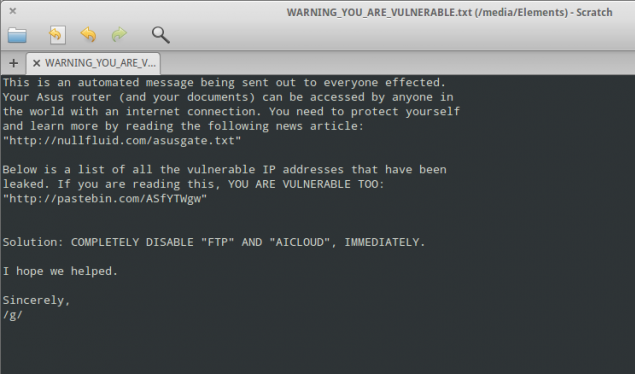
Exploit allows Asus routers to be hacked from local network

A vulnerability in Asuswrt, the firmware running on many wireless router models from Asustek Computer, allows attackers to completely compromise the affected devices. Malicious hackers, however, need to launch their attacks from within the local networks served by the vulnerable routers.


The flaw is located in a service called infosvr, which runs on Asuswrt-powered routers by default. The service, which is used by a tool called the Asus Wireless Router Device Discovery Utility, listens to packets sent to the router's LAN (local area network) interface over UDP broadcast port 9999.

"This service runs with root privileges and contains an unauthenticated command execution vulnerability," security researcher Joshua Drake, who found the vulnerability, said on his GitHub account.

Drake published his findings after someone else independently found the same issue and released an exploit for it.

While attackers can't exploit this flaw from the Internet, they can use it to gain control of routers if they first compromise a device connected to them or if they manage to connect to the local network in some other way. Any local computer infected with malware can therefore become a serious threat to a router that's vulnerable to this attack.

Routers are valuable targets for attackers, because they provide them with a foothold inside networks from where they can attack other devices. A router compromise is much harder to detect than a PC infection, because there are no antivirus programs running on such devices.

By controlling routers attackers gain the ability to intercept, inspect and modify incoming and outgoing Internet traffic for all devices that connect through them. Among other things, they can strip SSL from secure traffic and use DNS hijacking techniques to misrepresent legitimate websites.

Until Asus releases firmware updates for the affected routers, there are several mitigations available, although applying some of them requires technical skills.

The simplest way to block potential exploits for this vulnerability is to create a firewall rule that blocks UDP port 9999 on the router, but unfortunately this cannot be done through the Web-based administration interface. Users will have to connect to their router via Telnet and type "iptables -I INPUT -p udp --dport 9999 -j DROP" without the quotes on the command line interface.

The command sets up a firewall rule to block UDP port 9999, but it's not persistent across reboots so the procedure needs to be repeated every time the router restarts.

Eric Sauvageau, the maintainer of Asuswrt-Merlin, a popular custom firmware for Asus routers that is based on Asus' unified Asuswrt firmware, suggested a persistent fix that involves using the non-volatile JFFS partition available on Asus routers.

Users who run Asuswrt-Merlin on their routers can simply upgrade to version 376.49_5 of the firmware, which contains a fix for this vulnerability. Howerver, it should be noted that installing custom firmware can void the device warranty and should only be done by users who understand and accept all the risks associated with this procedure, including the possibility that their device might be damaged.