::Trend Micro Threat Resource Center::

06 August 2014

Russian criminals steal 1.2 billion passwords

Russian criminals have stolen 1.2 billion Internet user names and passwords, amassing what could be the largest collection of stolen digital credentials in history, a respected security firm said Tuesday.


The news was first reported by The New York Times, which cited research from Milwaukee-based Hold Security. The firm didn't reveal the identities of the targeted websites, citing nondisclosure agreements and a desire to prevent existing vulnerabilities from being more widely exploited.

Hold Security founder Alex Holden told CNNMoney that the trove includes credentials gathered from over 420,000 websites -- both smaller sites as well as "household names." The criminals didn't breach any major email providers, he said.

Alex Holden of Hold Security said most of the targeted websites were still vulnerable.

Holden said the gang makes its money by sending out spam for bogus products like weight-loss pills, and had apparently amassed its collection of digital credentials for that relatively innocuous purpose.

"It's really not that impactful to the individuals, and that's why they were under the radar for so long," Holden said. "They've ignored financial information almost completely."

But Holden said the gang's success at amassing passwords demonstrates that weak security procedures are common on websites of all sizes.

The criminals began collecting user data a few years ago by simply buying it on the black market. Their stash has grown significantly this year thanks to their use of an automated program that trawls the Internet to find vulnerabilities on websites, Holden said.

The reported theft dwarfs the one revealed last year by discount retailer Target, which admitted in December that hackers had stolen credit- and debit-card data from 40 million accounts.

Hackers from Russia and Eastern Europe are known for launching sophisticated cyberattacks for financial gain. Beyond spam, organized crime syndicates in the region have engaged in more sophisticated activities like corporate espionage and the theft of credit-card details.

The extent of the theft shows people need to better manage their credentials, cybersecurity experts say. Most people keep the same password for multiple services, such as banking, email and social media accounts. That allows hackers to turn a single password database into a treasure trove.

One simple way to stem the damage is to use two-factor authentication whenever possible to sign into online services, said Eric Cowperthwaite, an executive at network security provider Core Security. This method requires you to enter a second password, usually generated by your smartphone, upon login.

Jay Kaplan, CEO of cybersecurity firm Synack, criticized the companies involved for not being alert enough about their own security.

"It's likely that most of them do not even realize how many times they've been compromised," he said.

05 August 2014

Do We Want Google To Have This Much Power; Child Pornographer Caught By Gmail Scan.


A slightly disturbing piece of news: a child pornographer has been caught as a result of Google scanning his emails for known images of child abuse.

Hundreds of millions of email accounts are now being routinely scanned for illegal images, thanks to sophisticated new Google software
"Technology giant Google has developed state of the art software which proactively scours hundreds of millions of email accounts for images of child abuse.
The breakthrough means paedophiles around the world will no longer be able to store and send vile images via email without the risk of their crimes becoming known to the authorities.
Details of the software emerged after a 41-year-old convicted sex offender was arrested in Texas for possession of child abuse images.
Police in the United States revealed that Google’s sophisticated search system had identified suspect material in an email sent by a man in Houston. 
Child protection experts were automatically tipped off and were then able to alert the police, who swooped after requesting the user’s personal information from Google."
Yes, we know that Google has been scanning our Gmail in order to serve us ads. But this newer link into the criminal justice system is worrying. For of course such a tactic is not going to remain applied to one crime and one crime only. We can easily enough imagine extensions of it to mentions perhaps of drugs, or drug dealing. Or in countries with a rather lower level of protection for civil liberty than our own for certain buzzwords to do with the politics of those countries. And don’t forget that Google is subject to the laws of the countries in which it operates. If, say, China requires that emails that contain “Tiananmen Square” be reported to the Chinese security agencies then Google will have to comply or not do business in that country (and I think Google has declined to do some work inside China on that basis and Yahoo has not so declined).

The point being that having now shown that they can monitor email for the proof of one crime the company will come under ever greater pressure from a number of sources to apply the same monitoring techniques to evidence of other crimes. And there’s plenty of place around the world where it is criminal to do things we regard as being a lot more benign than child pornography. Even, places where it’s illegal to do things that we consider to be basic human rights. It seems to me inevitable that this technique, however just people may think it to be for this one particular crime, is going to expand out to many others.

Of course, one can simply not use Gmail, one can also simply not do anything that might constitute a crime, but it’s still worrying to me that our communications are to be so vetted.

01 August 2014

10 Malware Removal Apps Tested, guess which one came out on top?

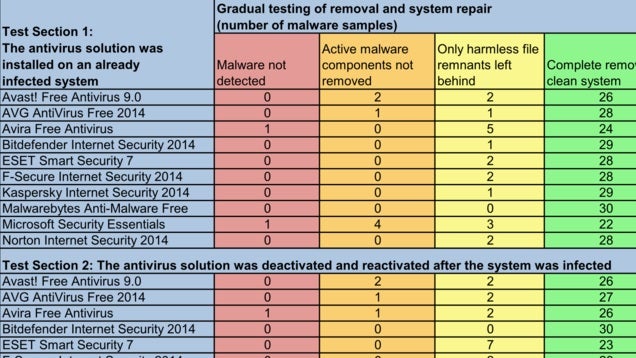
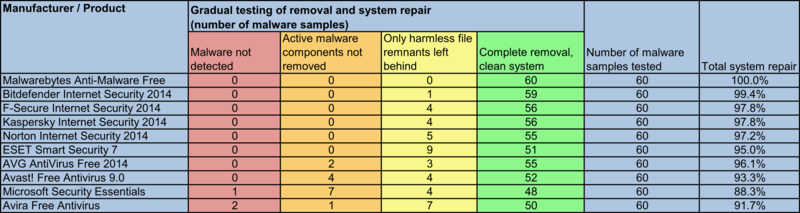
A recent test done by the independent antivirus research group AV-TEST took a look at the performance of today's most popular malware removal applications. Most of the applications showed excellent performance, but only Malwarebytes - a free download - managed a perfect score.

(Click to enlarge)

AV-TEST sought to answer an important question: can anti-malware software completely clean up and repair a Windows system after an attack?

    It's a worst-case scenario many users have experienced: Malware defeats the security barriers of their system and becomes embedded there. Is it even possible, in the aftermath of such an attack, to restore the Windows system to its previous condition? It ought to work with the help of antivirus software or clean-up tools. But how effectively do these first responders do their job?

The good news is that overall each application was very effective at providing cleanup and repair to Windows machines, which is important if you think someone has broken into your machine or downloaded some suspicious plugins.

Each application was put through a rigorous endurance test that lasted a total of 10 months. During this time several different malware families were tested repeatedly and the malware even underwent constant evolution along the way. All of the samples used were already known to the removal applications, so the primary purpose of the test was efficiency in detection, complete removal, and restoration. Tests were also conducted on antivirus software, but keep in mind there's a difference between antivirus and anti-malware.

(Click to enlarge)

In the end, Malwarebytes Anti-Malware Free scored a cool 100% in total system repair. The paid apps Bitdefender Internet Security 2014 came close in second with a score of 99.4%, and F-Secure Internet Security 2014 tied with Kaspersky Internet Security 2014 at 97.8%. The next best scores for free applications came from AVG AntiVirus Free 2014 and Avast! Free Antivirus 9.0.

Remember, it's important to keep in mind that these were tested for malware removal and not for virus protection. We can show you what we think are the best desktop antivirus applications, and if you're curious to see how antivirus apps ranked at AV-TEST, click here to read more.

28 July 2014

Malware scare on Amazon.in

Amazon India, the Indian arm of the world’s biggest e-commerce player has certainly been making all the right moves and a few months ago reportedly hit the $200 million mark in sales and could hit the $1 billion number by March 2016.

Amazon India sells 15 million products across 20 product categories, which makes Amazon bigger in terms of products on offer than competitors Flipkart as well as Snapdeal.

Clearly, Amazon India is expanding at breakneck speed and one of the ways the company is doing it is by reducing the time between merchant registration and listing the first product, with Amazon India almost 2-3 weeks quicker than competition.

Now, this focus on speed may be coming back to bite Amazon on its backside. Because at least on one vendor’s product pages, dangerous malware has been detected by Google.

Yesterday, I was purchasing a product on Amazon.in, when I clicked on some other products by the same vendor and to my horror saw Google browser Chrome warning me on some product pages with a message stating that Google Chrome had blocked access to the page on www.amazon.in. The warning further said that “content from s.m2pub.com, a known malware distributor” had been inserted into the Amazon.in webpage, and that visiting the page was likely to infect my computer with malware.


I wrote to Amazon India asking for a comment. Amazon India’s first response was to point a finger back at me, saying that it could mean that my computer was infected. I wrote back explaining that I hadn’t got pop-up ads whenever I opened a new tab (a clear sign of my computer being infected), but had got an unambiguous message from Google Chrome warning me that certain webpages on Amazon.in were infected with malware.

Later an Amazon India spokesperson admitted the problem, though still claiming it was just a misconfiguration error. “We were made aware of the issue through a few customers. On review we found there to be a misconfiguration in a third party vendor code. We have since rectified it,” the Amazon India spokesperson said. Most likely, images, etc, uploaded by the third party vendor may have contained this malware and if true may indicate that Amazon’s security didn’t work as it should.

When it comes to online shopping, reputation is everything and Amazon certainly knows that. And once a user comes across malware warnings, he would also be wary of other Amazon features such as the one where your credit card details are stored for easier purchase the next time. We’ve all seen what happened to retailer Target after a breach, with the after effects claiming the Target CEO himself.

Ebay is another recent example after intruders managed to access its database. In fact, though Ebay India would not admit it, immediately after the attack even the Ebay India website was going slow on transactions and cancelling many transactions even after payment.

And while the Target and Ebay breaches have to do with the wealth of data stored on their servers, malware through webpages is one route to infiltrate inside corporate systems.

Amazon India needs to be careful. If it sacrifices security for speed, the price it pays could be very heavy and all its mega growth plans may just remain that–mere plans on paper

26 November 2013

Spying spotlight now on Singapore

KUALA LUMPUR: SINGAPORE is under the spotlight following the latest revelations that it is a key "third party" in providing intelligence on Malaysia to the "Five-Eyes" intelligence grouping.

According to top secret documents leaked by former United States intelligence contractor Edward Snowden, the city state, along with South Korea, were playing key roles in helping the US and Australia tap telecommunications links across Asia on the Internet backbone -- undersea fibre optic cables that shuttle online communications between countries.

Read more: Spying spotlight now on Singapore - General - New Straits Times http://www.nst.com.my/nation/general/spying-spotlight-now-on-singapore-1.412361#ixzz2ljnLt6M3

03 April 2013

Think twice before you rush to post your PII for that freebie on Facebook!

Looks like any other product Facebook page? Think again.
Click to enlarge

Another case of misuse of social media, by consumers - that is case study worthy.
I was alerted of people posting their personal particulars (or commonly known as PII in US) on Loreal Singapore's facebook wall in exchange for potential freebies. Read POTENTIAL.

Don't believe how crazy can that be? Here's proof:

Click to enlarge

There's just so much private data there waiting to be mined. The PII have been sanitized to protect their privacy, but I'm thinking my attempts will prove to be futile as the Facebook page is accessible by the general public even without logging in.