::Trend Micro Threat Resource Center::

11 February 2015

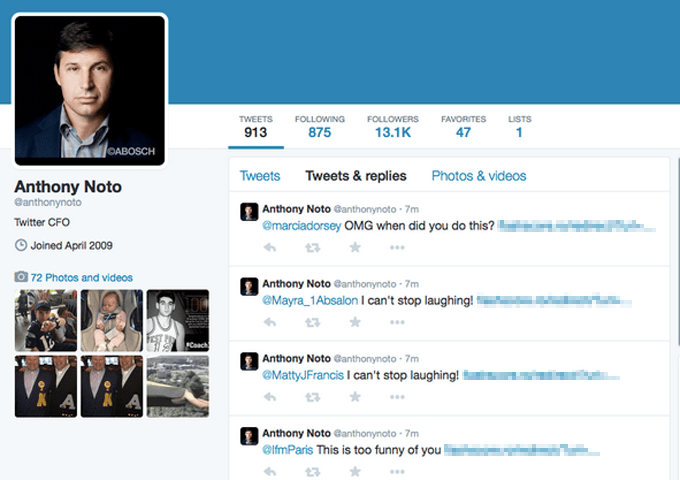
Twitter’s Own CFO Just Had His Twitter Account Hijacked

Twitter has a bit of a security problem. Taylor Swift, Chipotle, Newsweek — it seems each day brings another hijacked account or two.

Click to enlarge

For about 20 minutes this morning, Noto’s account was blasting out a massive torrent of spam.

It looks like the account was hijacked somewhere around 11:10 a.m. PT and recovered by 11:30. In that stretch, nearly 300 spam tweets were sent to some of Noto’s 13,000 followers.

Twitter has yet to comment on how the account might have been taken over. Given that it was used for spam rather than a political message, it’s possible that this wasn’t a targeted attack, instead relying on something like an old, forgotten API key left behind on a leaky third-party service.

It’s perhaps a bit revealing, though; if the company can’t keep the account of one of its own top executives locked down, what about its other 288 million active users?

07 February 2015

Espionage app targets iOS devices

Trend Micro has discovered an interesting poisoned pawn - spyware specifically designed for espionage on iOS devices. While spyware targeting Apple users is highly notable by itself, this particular spyware is also involved in a targeted attack.


The iOS malware found is among those advanced malware and it is believed the iOS malware gets installed on already compromised systems, and it is very similar to next stage SEDNIT malware Trend Micro found for Microsoft Windows’ systems. Two malicious iOS applications were found in Operation Pawn Storm. One is called XAgent and the other one uses the name of a legitimate iOS game, MadCap. XAgent is designed to work specifically with iOS7, which is still in one of every 5 iPhones and iPads. Fortunately, for iOS 8 devices, the user will see multiple notifications that the phone is trying to install an app. And it can’t run without the user launching. Both tools have the ability to record audio, which is very intrusive, and highly suggests the targeting of offline and confidential information.

Following analysis, Trend Micro concluded that both are applications related to SEDNIT – which is a spyware that aims to steal personal data, record audio, make screenshots, and send them to a remote command-and-control (C&C) server. Some of the data theft capabilities include:

  • Collect text messages
  • Get contact lists
  • Get pictures
  • Collect geo-location data
  • Start voice recording
  • Get a list of installed apps
  • Get a list of processes
  • Obtain Wi-Fi status

There may also be other methods of infection that are used to install this particular malware. One possible scenario is infecting an iPhone after connecting it to a compromised or infected Windows laptop via a USB cable.

For a more detailed analysis of the spyware, read here.

Background of Operation Pawn Storm
Operation Pawn Storm is an active economic and political cyber-espionage operation that targets a wide range of entities, like the military, governments, defense industries, and the media.

The actors of Pawn Storm tend to first move a lot of pawns in the hopes they come close to their actual, high profile targets. When they finally successfully infect a high profile target, they might decide to move their next pawn forward: advanced espionage malware.

The iOS malware we found is among those advanced malware. We believe the iOS malware gets installed on already compromised systems, and it is very similar to next stage SEDNIT malware we have found for Microsoft Windows’ systems.

06 February 2015

Highly critical “Ghost” allowing code execution affects most Linux systems

An extremely critical vulnerability affecting most Linux distributions gives attackers the ability to execute malicious code on servers used to deliver e-mail, host webpages, and carry out other vital functions.


The vulnerability in the GNU C Library (glibc) represents a major Internet threat, in some ways comparable to the Heartbleed and Shellshock bugs that came to light last year. The bug, which is being dubbed "Ghost" by some researchers, has the common vulnerability and exposures designation of CVE-2015-0235. While a patch was issued two years ago, most Linux versions used in production systems remain unprotected at the moment. What's more, patching systems requires core functions or the entire affected server to be rebooted, a requirement that may cause some systems to remain vulnerable for some time to come.

The buffer overflow flaw resides in __nss_hostname_digits_dots(), a glibc function that's invoked by the gethostbyname() and gethostbyname2() function calls. A remote attacker able to call either of these functions could exploit the flaw to execute arbitrary code with the permissions of the user running the application. In a blog post published Tuesday, researchers from security firm Qualys said they were able to write proof-of-concept exploit code that carried out a full-fledged remote code execution attack against the Exim mail server. The exploit bypassed all existing exploit protections available on both 32-bit and 64-bit systems, including address space layout randomization, position independent executions, and no execute protections. Qualys has not yet published the exploit code but eventually plans to make it available as a Metasploit module.

“A lot of collateral damage on the Internet”

The glibc is the most common code library used by Linux. It contains standard functions that programs written in the C and C++ languages use to carry out common tasks. The vulnerability also affects Linux programs written in Python, Ruby, and most other languages because they also rely on glibc. As a result, most Linux systems should be presumed vulnerable unless they run an alternative to glibc or use a glibc version that contains the update from two years ago. The specter of so many systems being susceptible to an exploit with such severe consequences is prompting concern among many security professionals.

Besides Exim, other Linux components or apps that are potentially vulnerable to Ghost include MySQL servers, Secure Shell servers, form submission apps, and other types of mail servers.

It was reported that Qualys researchers enumerated apps they believed were not vulnerable. The list included Apache, Cups, Dovecot, GnuPG, isc-dhcp, lighttpd, mariadb/mysql, nfs-utils, nginx, nodejs, openldap, openssh, postfix, proftpd, pure-ftpd, rsyslog, samba, sendmail, sysklogd, syslog-ng, tcp_wrappers, vsftpd, and xinetd.

"If [researchers] were able to remotely exploit a pretty modern version of Exim with full exploit mitigations, that's pretty severe," said Jon Oberheide, a Linux security expert and the CTO of two-factor authentication service Duo Security. "There could be a lot of collateral damage on the Internet if this exploit gets published publicly, which it looks like they plan to do, and if other people start to write exploits for other targets."

The bug affects virtually all Linux-based software that performs domain name resolution. As result, it most likely can be exploited not only against servers but also client applications. Word of the vulnerability appears to have caught developers of the Ubuntu, Debian, and Red Hat distributions of Linux off guard. At the time this post was being prepared they appeared to be aware of the bug but had not yet distributed a ready-made fix. People who administer Linux systems should closely monitor official channels for information about how specific distributions are affected and whether a patch is available. Admins should also prepare for the inevitable reboots that will be required after installing the patch.

Update: Red Hat Enterprise Linux 5, has an update here, and readers are reporting a fix is also available for Ubuntu 12.04.

In the meantime, readers can find more technical details about Ghost in the previously mentioned Qualys blog post, as well as here and here.

.

05 February 2015

Serious bug in fully patched Internet Explorer puts user credentials at risk

A vulnerability in fully patched versions of Internet Explorer allows attackers to steal login credentials and inject malicious content into users' browsing sessions. Microsoft officials said they're working on a fix for the bug, which works successfully on IE 11 running on both Windows 7 and 8.1.


The vulnerability is known as a universal cross-site scripting (XSS) bug. It allows attackers to bypass the same origin policy, a crucially important principle in Web application models that prevents one site from accessing or modifying browser cookies or other content set by any other site. A proof-of-concept exploit published in the past few days shows how websites can violate this rule when people use supported versions of Internet Explorer running the latest patches to visit maliciously crafted pages.

To demonstrate the attack, the demo injects the words "Hacked by Deusen" into the website of the Daily Mail. But it also could have stolen HTML-based data the news site, or any other website, stores on visitors' computers. That means it would be trivial for attackers to use it to steal authentication cookies many websites use to grant access to user accounts once a visitor has entered a user name and password. Once in possession of the cookie, an attacker could access the same restricted areas normally available only to the victim, including those with credit card data, browsing histories, and other confidential data. Phishers could also exploit the bug to trick people into divulging passwords for sensitive sites.

The exploit appears to use iframes to tamper with IE's support of the same origin policy. The exploit code looks like this:

function go()
{
w=window.frames[0];
w.setTimeout("alert(eval('x=top.frames[1];r=confirm(\\'Close this window after 3 seconds...\\');x.location=\\'javascript:%22%3Cscript%3Efunction%20a()%7Bw.document.body.innerHTML%3D%27%3Ca%20style%3Dfont-size%3A50px%3EHacked%20by%20Deusen%3C%2Fa%3E%27%3B%7D%20function%20o()%7Bw%3Dwindow.open(%27http%3A%2F%2Fwww.dailymail.co.uk%27%2C%27_blank%27%2C%27top%3D0%2C%20left%3D0%2C%20width%3D800%2C%20height%3D600%2C%20location%3Dyes%2C%20scrollbars%3Dyes%27)%3BsetTimeout(%27a()%27%2C7000)%3B%7D%3C%2Fscript%3E%3Ca%20href%3D%27javascript%3Ao()%3Bvoid(0)%3B%27%3EGo%3C%2Fa%3E%22\\';'))",1);
}
setTimeout("go()",1000);

A Microsoft spokesperson issued the following statement:

We are not aware of this vulnerability being actively exploited and are working on a security update. To exploit this, an adversary would first need to lure the user to a malicious website, often through phishing. SmartScreen, which is on by default in newer versions of Internet Explorer, helps protect against phishing websites. We continue to encourage customers to avoid opening links from untrusted sources and visiting untrusted sites, and to log out when leaving sites to help protect their information.
The statement is correct in pointing out that to succeed, an attacker would first have to lure a target to a malicious site. In an age of social networking and shortened links, that's not a difficult burden to meet. And while SmartScreen could be an effective remedy, it would take some time for it to be put in place. And even then, SmartScreen would work only against attacks that are spammed to large numbers of people. SmartScreen would likely do nothing to prevent targeted attacks.

04 February 2015

Hacked Hotel Phones Fueled Bank Phishing Scams

A recent phishing campaign targeting customers of several major U.S. banks was powered by text messages directing recipients to call hacked phone lines at Holiday Inn locations in the south. Such attacks are not new, but this one is a timely reminder that phishers increasingly are using lures blasted out via SMS as more banks turn to text messaging to communicate with customers about account activity.

The above-mentioned phishing attacks were actually a mix of scams known as “SMiShing” — phishing lures sent via SMS text message — and voice phishing or “vishing,” where consumers are directed to call a number that answers with a voice prompt spoofing the bank and instructing the caller to enter his credit card number and expiration date.

Over the past two weeks, fraudsters have been blasting out SMS messages to hundreds of thousands of mobile users in the Houston, Texas area. The messages alerted recipients about supposed problems with their bank account, urging them to call a supplied number and follow the automated voice prompts to validate or verify their credit card account information.

On Saturday, Jan. 30, I called one of the numbers that was sent out in the smishing/vishing scam — 281-866-0500 – which is the main phone line for a Holiday Inn Express in Houston. At the time, calls to the number went straight to an automated voice prompt targeting Bank of America customers:

“Thank you for calling Bank of America. A text message has been sent to inform you that your debit card has been limited due to a security issue. To reactivate, please press one now.” After pressing one, the caller is prompted to enter the last four digits of their Social Security number, and then the full card number and expiration date.

My recording of the call was garbled, but here’s a copy of a very similar voice prompt targeting Key Bank customers earlier in January that also was run off the fax line tied to a different Holiday Inn a few miles away in Houston [number: 832-237-8999], according to Numbercop, a telephony threat intelligence firm.

Holiday Inn’s corporate office did not return calls seeking comment, but the company apparently got the message because the phone lines were answering normally on Monday. A front desk clerk who answered the line on Tuesday said the hotel received over 100 complaints from people who got text messages prompting them to call the hotel’s main number during the time it was hacked.

According to Jan Volzke, Numbercop’s chief executive, these scams typically start on a Saturday afternoon and run through the weekend when targeted banks are typically closed.

“Two separate Holiday Inns getting hijacked in such short time suggests there is a larger issue at work with their telephone system provider,” he said. “That phone line is probably sitting right next to the credit card machine of the Holiday Inn. In a way this is just another retail terminal, and if they can’t secure their phone lines, maybe you shouldn’t be giving them your credit card.”

Volzke said the recipients of the phony texts in Houston were geo-targeted by area code.

“The texts were sent in bursts with varying bank affiliations, including Bank of America, Fifth Third Bank, and Susquehanna Bank,” he said. “The campaign last week was an identical case to one a week or so earlier that referenced Key Bank, Bank of America and Wells Fargo.”

Numbercop says the text message lures were sent using email-to-SMS gateways, but that the company also has seen similar campaigns sent from regular in-network numbers (prepaid mobile phones e.g.), which can be harder to catch. In addition, Volzke said, phishers often will target AT&T and Verizon users for use in furthering these schemes.


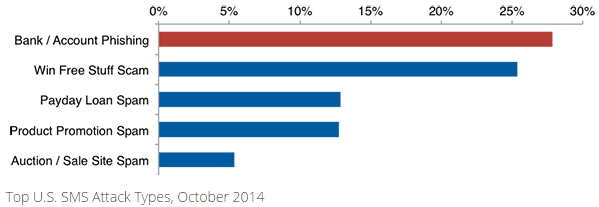
Many banks now offer their customers the ability to receive text message alerts about activity on their credit card accounts — such as recent transactions — so it’s not surprising that crooks are exploiting this medium. While vishing and SMiShing attacks are not new (see this story from 2010), they are on the rise: According to Cloudmark, the incidence of SMS bank account phishing in the U.S. more than tripled in September 2014. Cloudmark’s recently released Annual Threat Report found more than one in four unsolicited SMS messages reported in 2014 attempted to steal the victim’s personal or financial information.

Volzke says it’s unfortunate that more financial institutions aren’t communicating with their customers via mobile banking apps.

“Banking apps are among the most frequently downloaded and used apps,” Volzke said. “If the user has an app from the bank installed, then if the bank really has something to say they should use the in-app messaging method, not text messages which can be spoofed and are not secure. And yet we see almost no bank making use of this.”

Regardless of whether you communicate with your bank via text message, avoid calling phone numbers or clicking links that appear to have been sent via text message from your bank. Also, be extremely wary of any incoming calls from someone calling from your bank. If you think there may be an issue with your account, your best bet is to simply call the number on the back of your credit or debit card.
03 February 2015

Hackers target third new zero-day for Adobe Flash


Security researchers have advised users of Adobe's Flash Player to disable the software temporarily, as yet another remotely exploitable vulnerability is being actively attacked by would-be hackers.

The bug has the potential to allow attackers to take full control of users' computers without their interaction.

Recently-released Flash Player versions 16.0.0.296 for Microsoft Windows and Apple OS X are vulnerable to the CVE-2015-0313 vulnerability, which Adobe rates as critical. Versions 13.0.0.264 and earlier are also vulnerable, along with Flash Player 11.2.202.440 and earlier for Linux.

Security vendor Trend Micro is credited with discovering the new zero-day vulnerability alongside two Microsoft researchers.

The company said CVE-2015-0313 is being actively exploited in drive-by attacks delivered via malicious advertisements, believed to have been executed through the Angler Exploit Kit.

"Malvertisements" on popular websites redirect visitors to a series of other sites, finally landing at a Russian-registered domain that attempts to deliver the payload that executes the exploit.

Trend Micro said it has already counted over 3000 hits related to CVE-2015-0313, suggesting the vulnerability is being widely used by attackers.

Neither the security vendor nor Adobe have yet published a full analysis of the new zero-day, which is the third to strike the popular Flash Player software in a month.