::Trend Micro Threat Resource Center::

03 January 2010

Adobe predicted to Surpass Microsoft As top Malware Target in 2010

Adobe predicted to Surpass Microsoft As top Malware Target

Adobe Flash and Acrobat are popular standard tools for users. Any unpatched vulnerabilities provide wide targets for malware developers. It is essential to keep both of these products patched to ensure the best levels of safety. Also users should avoids avoid any suspicious items presented to them in email or web browsing.

Adobe predicted to Surpass Microsoft As top Malware Target in 2010
http://www.informationweek.com/news/security/vulnerabilities/showArticle.jhtml?articleID=222100263

QUOTE: Adobe Reader and Flash will surpass Microsoft Office applications as favorite targets of cybercriminals, a security vendor predicted Tuesday. In unveiling its 2010 Threat Predictions report, McAfee said the growing popularity of the Adobe products has attracted the attention of cybercriminals, who have been increasingly targeting the applications. Adobe Reader and Flash are two of the most widely deployed applications in the world. As a result of Adobe's success in client software, McAfee Labs believes "Adobe product exploitation will likely surpass that of Microsoft Office applications in 2010."

McAfee Threats prediction 2010
http://www.mcafee.com/us/local_content/white_papers/7985rpt_labs_threat_predict_1209_v2.pdf

30 December 2009

Twitter bans obvious passwords

An applause for Twitter which has recently made it so that when you sign up for an account you can't use one of those very obvious passwords.

Here is a list of the passwords (courtesy of The Wundercounter)

So, if you currently use passwords which resemble any of those listed, I would encourage you to change them as soon as possible.

Researchers Prepare Practical Demonstration Of GSM Encryption Cracking Technology

GSM calls can be intercepted and decoded using low-cost hardware and open-source software, researchers say.

Security researchers Karsten Nohl and Chris Paget presented their findings in a presentation (WMV video) Monday at the 26th Chaos Communication Congress (CCC) in Berlin. A practical demonstration of the vulnerabilities and potential exploits is scheduled to take place at the conference on Wednesday at 12:00 GMT.

The demonstration is a follow-up to a presentation the two researchers made in August at the Hacking At Random conference, during which they outlined serious flaws in the GSM encryption scheme.

GSM is used in approximately 80 percent of the world's mobile communications systems, and in about 3 billion cell phones across the globe, according to industry estimates. In his CCC presentation yesterday, Nohl pointed out that much data has already been published about GSM's vulnerabilities, but the pair's new research takes it one step further -- by showing how GSM calls can be intercepted and decoded using relatively low-cost hardware and open-source software that is readily available on the Web.

Organizations should assume that within six months of the demo GSM phone calls will be at risk, says Stan Schatt, vice president and practice director for healthcare and security at ABI Research.

For full report, read here.

29 December 2009

Phishers prefer Paypal, Visa, eBay and Amex

Compared to the first half of 2009, the amount of phishing messages has remained relatively unchanged, although phishers have switched their focus to institutions that could bring them the most profit in the shortest timeframe. This is one of the results of BitDefender's malware and spam survey.

Primary targets are PayPal, Visa and eBay, followed by HSBC, American Express and Abbey Bank. Ally Bank and Bank of America rank last with a little over one percent of the total amount of phishing messages. These messages mostly target English-speaking computer users who are using the services of at least one of the institutions previously mentioned.

BitDefender Labs found that most web 2.0 phishing attempts in the first half of 2009 relied on social engineering schemes and speculated user naivety. The Twitter Porn Name scam is a good example. Users were invited to reveal their first pet name, as well as the first street on which they lived. These names are usually employed as backup/security questions. An e-crook possessing a person’s username along with these “clues” can easily retrieve a password that he or she can later employ to access the account and send spam, access transactions, or use the account in whatever way necessary to make a profit, including demanding a ransom for release of the hijacked account.

“2009 witnessed a wide range of security threats aiming at both end-users and at corporate networks,” Vâlceanu commented. “Extra caution and a highly-rated antimalware solution with antispam, antiphishing and antimalware modules are a must-have for anyone surfing the web in 2010.”

27 December 2009

(Not So) Happy Holidays from Koobface

New variants of Koobface are emerging that attempt to trick Facebook users in to downloading fun images or gifts, associated with the holiday season. Please be careful on all social networks as they are very popular and a target for malware writers and criminals to take advantage of folks.

Extract from report:
"Activities associated with
Koobface have increased during the month of December. This morning we noticed a trend with some of the domain-based locations making use of the holiday theme. This has included everything from “presents for your pets” to “festive holiday trees” – these are domains that appear legitimate but are not.

When users go to these sites for these happy holiday thoughts – they are instead instantly greeted by having files downloaded to their computers. And voila – a lovely “gift” is attempting to execute upon them. The gift of holiday identity theft!"

23 December 2009

Facebook Hit By Clickjacking Attack

Facebook is cleaning up after a clickjacking attack that infiltrated the social networking site this week -- and security experts say this won't be the last such attack.

Clickjacking, in which an attacker slips a malicious link or malware onto a legitimate Web page that appears to contain normal content, is an emerging threat experts have been warning about.

The attack on Facebook was in the form of a comment on a user's account with a photo that lured the victim to click on it.
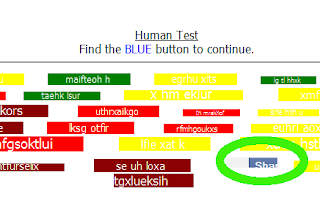
The embedded link took the victim to a Web page that presented like a CAPTCHA or Turing test, and asked the user to click on a blue "Share" button on the Facebook page. (as shown below)
Once clicked, the victim is redirected to a YouTube video, and then the same post shows up on the victim's account and thus tries to infect his or her friends. Security experts say the attack appeared to be more of a prank or trial balloon, and it affects only Firefox and Chrome browsers, according to security expert Krzysztof Kotowicz, who blogged about the attack this week.

Facebook has now blocked the URL to the malicious site, fb.59.to.

Full reports here and here.